The Hackathon presented projects for the reconstruction and construction of new schools in different regions of Ukraine.
During the war, the issues of preserving Ukrainian identity and passing it on to future generations became more important. Education plays a key role in this process. And in order to make the educational process more enjoyable and easy, the educational space is of great importance. Realizing this, the participants of the 100 Ideas for Cities Hackathon paid considerable attention to the renovation of educational spaces. The ideas proposed by the volunteers embody modern approaches to the arrangement of educational institutions: inclusiveness, multifunctionality, energy efficiency, and environmental friendliness. At the same time, the authors of the proposed projects do not forget about heritage and preservation of historical memory, incorporating ethnic motifs and even using the remains of buildings destroyed by the war.
Restoration of a secondary school in Bakhmut
As part of the IRS Hackathon "100 Ideas for Cities," volunteers propose to restore the building of Bakhmut Secondary School #24.
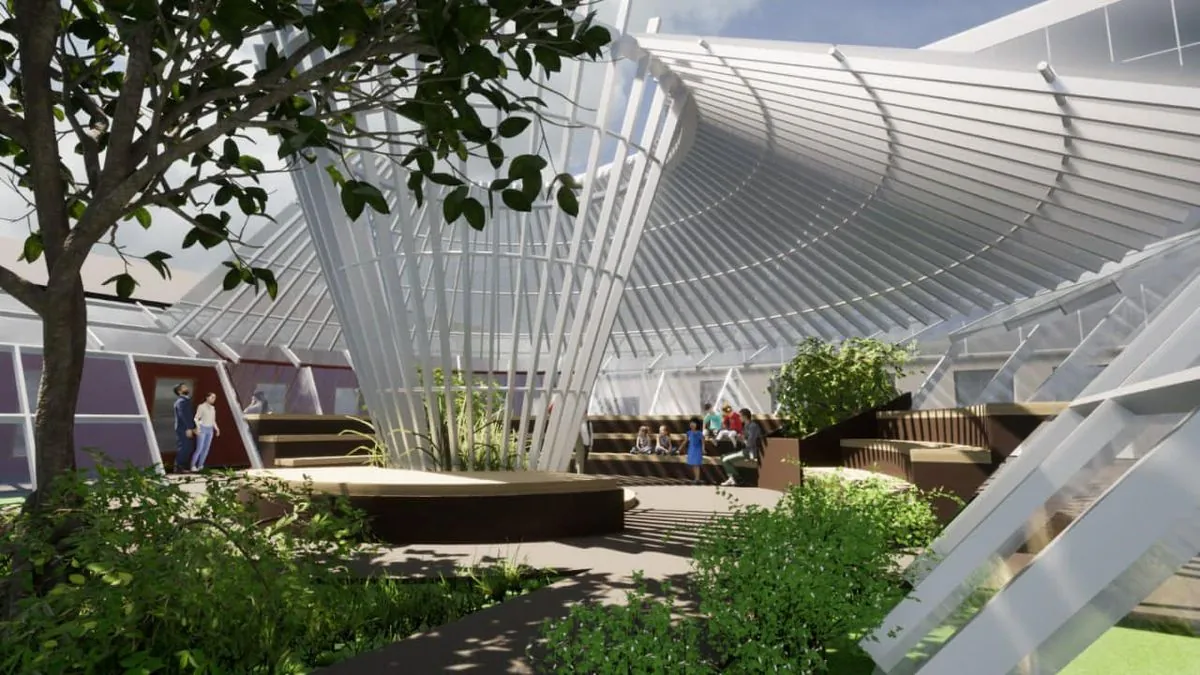
The team has developed a modern public space that meets the needs of today, including a safe and comfortable infrastructure for pedestrians. The design principle is to clearly delineate the functions of the school and simultaneously combine them in a glazed atrium with pedestrian bridges, which becomes the center of the school. Classrooms are proposed to be located in the wings of the streets, and shared workplaces and public access areas should be located in a separate building on the northern part of the territory facing the park.
The foundations of the previous school building are also included in the project, which will give students a sense of heritage and contribute to their social development. The project provides for a well-developed infrastructure, including art classes, a fablab, a canteen, a gym with a climbing wall, a library, physics and chemistry classes with advanced equipment. The building is clearly zoned, with public infrastructure on the ground floor, where the canteen, fablab and art classes are located. This will allow the premises to be used outside of school hours. The project also envisages the expansion of the school as a local community and cultural center, in line with global trends. The educational part occupies floors 2 through 5 and can be easily separated.
Interesting fact
The architecture of the school teaches: brick, concrete, glass, wood – the natural materials used do not imitate anything, reflect the essence of their work in the construction of the building and children will gain knowledge about the physical characteristics, even see the process of natural aging of materials. There is also the possibility of access to the roof, with an educational area where students will learn how to grow plants. In addition, it is planned to place solar panels there, and students will be able to learn the principle of their operation and how they form Energy.
The author of the idea was Vladislava Terekhova, a 3rd-year student of the National University "Kharkiv National University of urban economy named after Beketov"
The authors of another architectural plan for the restoration of this school propose to make an atrium on the site of the destroyed part of the school – it will be a three-level school-wide space, including the main lobby, forum, foyer of the assembly hall and recreational spaces. This space has both a main entrance from the street and an exit to the school-wide event area in the courtyard. the Assembly Hall is also proposed to be expanded. In addition, it is proposed to build a new building of the primary school with classrooms, workshops, a universal hall, rooms for extended day groups and places for recreation.
On the other side of the complex, the possibility of expanding the workshop building, creating laboratories and recreation areas is being considered. The design of the facades was based on modern school architecture, as well as the historic buildings of Bakhmut. It is also proposed to insulate the facades with modern energy-saving approaches, and to place solar panels on the roofs of the buildings.
Also, the authors of the project suggested taking into account the terrain – the school is located on a site with a slope, and this makes it possible to build a basement and equip a shelter there.
The plans also include parterre areas, bicycle parking, parking for school buses, green areas and sports grounds.
Project authors
Alexandra Buimister, student of the Environmental Design program at the Kyiv National University of technology and design.
Daniil Kosenko, curator, head of the Department of interior design and furniture of KNUTD, candidate of art history, architect.
Reconstruction of the Kodyma Lyceum
Participants of the Hackathon offer reconstruction of the Kodymsky Lyceum No. 1 of the Podolsk District of the Odessa region.
The project involves the reconstruction of the current school building and the addition of new sections. The condition of the existing building is poor. The floor is crumbling, and the building itself does not meet modern needs and energy efficiency requirements.
The authors of the project propose a new spatial composition that will meet modern pedagogical approaches and European requirements.
The school complex proposed by the architects consists of modular learning spaces with wooden walls that can be customized to create different room sizes. Different entrances meet the needs of learning. At the entrance to the school, it is proposed to place a conference room and a secretary's desk, with space for students to work. The school should be open, flexible and multifunctional, serving both educational and community purposes. This hall, the agora, can become a place for community events. The sequence of classrooms offers a variety of uses for lessons, meetings, and laboratories.
The project also provides for the creation of a hostel that will have a modular configuration of rooms.
The building's exterior terraces provide intimate spaces for reading and socializing, with curtains for privacy. Common spaces will host meetings and sporting events.
Externally, the building has a protective brick shell and wooden interior elements. Solar panels on the roof generate electricity with rainwater recovery systems. X-Lam walls and sliding panels create adaptive spaces. It is proposed to use factory CLT elements (CLT or multi – layer glued wooden panel, consisting of at least three layers of solid lumber glued together, which are laid in mutually perpendicular directions-ed.), which accelerate construction. A significant innovation is the terrace, which provides a Large play space controlled by teachers.
Views from the terraces will accentuate the landscape and park below. Roof gardens will protect from weather conditions and improve thermal insulation.
Interesting fact
In the dorm, thanks to curtains and panels, it will be possible to combine or divide rooms, creating a kind of small apartments or consecutive single rooms. Thus, it can initially serve as a refugee shelter, in the future it can be similar to a college, and later it can be converted into a hotel or guest house.
Project authors
The working group from the Polytechnic University of Milan: architect Franco Tagliabue and professor Filippo Piascentin.
The authors of another project for the reconstruction of the Kodym Lyceum suggest first of all to focus on the restoration of the building of the former hostel, which has not been used since 2005. In their project, they tried to ensure accessibility, energy efficiency and aesthetic appeal of the building.
The team suggests updating the entrance group, recreation areas, most of the furniture for the building, sun protection for vulnerable areas, and adding a vestibule passage to the school building on all levels where a lift is installed.
Authors of the project
Architects, students of the Kiev National University of construction and architecture: Yulia Nedoluzhko, Alexandra Piven, Marta Kozerenko.
Curator: Tatiana Kashchenko, candidate of architecture, associate professor of the Department of architectural design of civil buildings and structures of the Kiev National University of construction and architecture.
Reconstruction of a school complex in Gostomel
Volunteers are proposing the reconstruction of a school complex in Gostomel, Kyiv region. This project is imbued with symbolism and has great potential for revitalizing the village.
Now the school buildings and the surrounding area are abandoned. Volunteers propose to radically change the situation, while at the same time using what is now cluttering up the territory to arrange open spaces, thereby emphasizing the revival of the town. The goal is to transform what was destroyed into something even better.
The school complex proposed by the authors of the project consists of various educational institutions with large intersecting spaces. These spaces can serve not only as a place for children to learn, but also for the general public. It is proposed to expand pedestrian and bicycle accessibility to promote a more vibrant city.
The layout revolves around two central courtyards, with a gym and kindergarten separated by a corridor for different age groups. The Sports Hall has a separate entrance for extracurricular use and a second floor for sporting events.
The school's project is based on the principles of openness, flexibility and adaptability, meeting the requirements of the European community for future educational spaces. The central Agora serves as the focal point of the building, with separate entrances for senior and junior schools and tree-lined courtyards. Two wings of the building, extending to the sky, are proposed to be equipped with photovoltaic systems (solar panel system – ed.) to generate electricity and collect rainwater for reuse. The patio, which will act as an impluvium (indoor pool – ED.), will emphasize the practice of sustainable water collection. The design of the school emphasizes separation and sharing between the two schools, allowing for interaction and shared spaces.
The terrace, which will be formed by the sloping roofs, offers a new play area for children with controlled supervision. The views from the terraces will extend the natural landscape, providing safe, soft-surfaced play areas.
Reusing the rubble of an old school building not only reduces waste, but also preserves collective memory. The mountain of rubble will serve as a recreational space for sporting events and Recreation, combining the old with the new in a harmonious way.
Project authors
Working group from the Polytechnic University of Milan: architect and Professor Franco Tagliabue together with Filippo Piazentin.
Creation of a new school in Krasnopolskaya hromada
In the Krasnoselsky territorial community in the Odessa region, volunteers propose to build a new modern school for 1,100 students.
The authors of the project aim to create a learning environment that promotes intellectual development, creativity and social interaction of students. The main idea is to unleash the creative potential of everyone who will study at this school.
The priority in the design of the new building was a harmonious combination of development with the projected general layout of the site and the psychology of students. It is based on the need to provide a harmonious space for the child's personal transformation.
The school is designed to meet high standards of energy efficiency and inclusiveness in education.
Project authors
The group is curated by Anatoly Davydov, head of the Department of Architectural Design, dean of the Faculty of architecture of the National Academy of Fine Arts and architecture, associate professor. Band members: Anastasia Doyar, Vladislava Levitskaya, Ekaterina Peskova ,Vyacheslav Nesterenko and Veronika Pinchuk
Another team of volunteers also offers a project for the reconstruction of the Krasnoselskaya hromada school. The authors of this project note that now the existing school building does not have enough space that would be properly equipped. The team proposes to turn the school into an inclusive learning space that can also function for the needs of the entire community.
Of course, for students, the school itself and its territory are accessible all day. But the public part of the building, which includes two blocks, namely the assembly hall and the library, is open to adults during extracurricular hours. The assembly hall can be used for events, performances, lectures, etc., and the library premises can be used for work or study. Also on the ground floor there is a dining room and a sports hall. The entrance and classrooms of the primary school are separated for the convenience of students. on the second and third floors there are classrooms and recreation areas for recreation during recess. A shelter for 600 people is provided on the underground floor. Public blocks and entrances are visually highlighted with a blue line, which is complemented by accent window frames on the facade.
Interesting fact
Solar panels, energy – saving windows, rainwater collection, green roofs and planting new trees also ensure the environmental friendliness and energy efficiency of the building.
Project authors
Mariia Molodcha, a student of the O.M. Beketov Kharkiv National University of Urban Economy.
Curator, Senior Lecturer of the Dept. Innovative Technologies in Urban Environment Design, A.M. Beketov KhNUIA – Kornilova Lyudmila
Boyar Harvard Project
As part of the hackathon, it is also proposed to create a functional school educational space "Boyarsky Harvard" on the basis of the Konovalets Lyceum with the preservation of the historical building of the existing school. Two projects are also presented in the competition.
The konovalets Lyceum in Boyarka, Kyiv region, has a rich history and is a historical architectural monument of the late 19th and early 20th centuries.this building was turned into a school, where 500 students study, who are forced to attend the institution in two shifts due to lack of space. recently replaced the roof with metal tiles, completed the dining room, but the assembly hall is missing. At the same time, a large number of ancient oaks grow on the territory of the Lyceum, which is the hallmark of this place.
In the first project, it is proposed to create an additional modern educational space on the territory of the Lyceum. The project includes a new school building consisting of a junior and high school building, a Stem Laboratory, a gym, a canteen, a hall, and a media library. An interesting and functional improvement of the territory is also planned, namely: a basketball and sports field, recreation areas, a children's playground and an unusual courtyard in the historical part of the Lyceum. Infrastructure for pedestrians and necessary driveways for fire transport are provided.
Interesting fact
The image of the new building plays in contrast to the Lyceum, and has a large number of glazing, which simultaneously improves the insolation of the premises and combines the building with nature.
Project authors
Student Of The Kiev National University of construction and architecture – Sirotsinskaya N. D.
Curator: head of the educational and Architectural Workshop, candidate of architecture, associate professor of the Department of APTSBS of the Kiev National University of construction and architecture Vladimir Priymak.
The authors of the second" Boyar Harvard " identified 5 Problem Areas in the arrangement of the existing Lyceum: public catering, recreation, space for learning (require expansion), an economic area near the classrooms, a small sports hall under which the former chapel is used.
The project proposes to leave the existing building for primary and build a new building for secondary and high schools. The authors propose to preserve the historical character, while using modern energy-efficient materials and ensuring inclusivity. The new building will have an atrium space that can be adapted to different needs. We also provide a food hall, gym, Museum and STEM laboratory.
Actually, as part of the second project, two options for transforming the Lyceum are proposed: with a glass transition and a freestanding one.
Interesting fact
The use of internal space for various needs of students is widespread abroad and, unfortunately, this is rare in domestic practice.
Project authors
Architect, Senior Lecturer of the Department of architecture of buildings and structures of the architectural and Art Institute of the Odessa State Academy of construction and architecture Andrey Chernenko.
The author of the idea, a 4th-year student of the Department of architecture of buildings and structures of the architectural and Art Institute of the Odessa State Academy of construction and architecture Lina Danilova.
Project curator, architect, doctor of philosophy in architecture and Urban Planning, assistant of the Department of architecture of buildings and structures of the architectural and Art Institute of the Odessa State Academy of construction and architecture Evgeny Dunaevsky.
Reconstruction of the Lyceum in Reshetilovka
Volunteers propose to reconstruct the existing Oleynik Lyceum in Reshetilovka, Poltava region.
The building does not meet the requirements of energy efficiency, the freezing facade and old roof do not allow children to function normally and provide appropriate learning conditions. After analyzing the history and culture of the community, the authors were inspired to create an idea for this particular town, taking into account its cultural heritage. The project combines modern architectural methods, materials and ethnic motifs.
This reconstruction also provides for the renewal and modernization of the school territory, the completion of evacuation stairs and bathrooms in the gym, not forgetting about ecology and landscaping. it is also proposed to equip the building with a winter garden. its premises can be used for conducting experiments on growing and studying plants in biology classes, as well as as a recreational area for students.
The authors of the idea are a student of the Institute of innovative education "Kiev National University of construction and architecture": Victoria Lobanchikova and Daria Levonchuk.
University campus in Mariupol
Not only schools, but also universities attracted the attention of hackathon participants. So the authors of another project propose the creation of a university campus of the Priazovsky State Technical University.
The main problems that existed even before the occupation and destruction of Mariupol are inconvenient public transport, insufficient attractiveness, a small commercial area and weak social ties.
The new campus is proposed to be built with an emphasis on eliminating these problems as much as possible. The campus should be technologically convenient and become a formative element in the rebuilt city.
The authors of the project see their mission in providing a learning environment where every student can actively develop and achieve success in all areas of knowledge. It is also proposed to create innovative spaces for creative work, cooperation and exchange of ideas between students of various specialties. The infrastructure should promote a healthy lifestyle by developing sports and recreational opportunities. The authors of the idea want to create a sustainable and environmentally friendly campus that will embody comfort, cooperation and development.
Authors of the idea
Architecture students of the Kiev National University of construction and architecture Shinkarchuk Maria, Bilokur Alexey, Lebed Bogdan, Roiko Nadezhda, Yurchik Ilya.
Curator: associate professor of the Department of architecture and urban planning of the Kiev National University of construction and architecture, – Vera Shpakovskaya.
About Hackathon "100 ideas for cities"
One of the largest projects to restore Ukrainian cities after the war is the Hackathon "100 ideas for cities", organized by The Project innovation and reconstruction for society (IRS) and the NGO "club of Mayors".
The hackathon has already brought significant results, bringing together 63 developed architectural ideas for participating communities from all over Ukraine. Currently, 250 applications have already been received from communities in 22 regions, which is about a hundred communities. the project involves 139 formed architectural teams, 20% from abroad: Belgium, Chile, Austria, the United Arab Emirates, the United States, Italy, the Netherlands and Slovakia.