Russian attacks across Ukraine killed at least eight civilians and injured at least 57 over the past day, regional authorities reported early on Dec. 11.
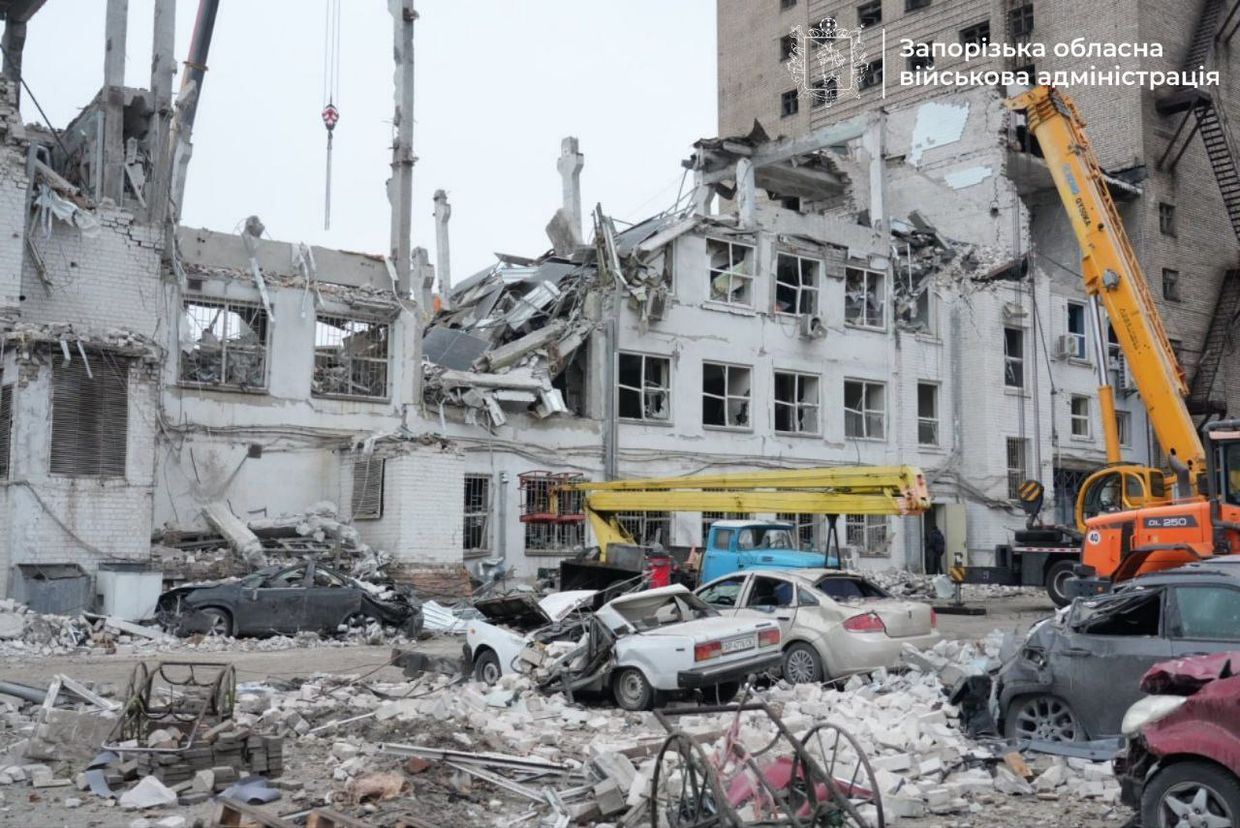
Russia launched a missile attack against the city of Zaporizhzhia late on Dec. 10, destroying a clinic, killing seven people, and injuring 22, officials said. At least 20 residential buildings were damaged.
Russian attacks against Kharkiv Oblast injured 19 people, Governor Oleh Syniehubov reported.
The vast majority — 17 — were recorded in the town of Zlatopil after Russia struck the city with two Iskander-M missiles, according to officials. Sixteen residential buildings were damaged.
A 63-year-old man was also injured in the village of Zapadne, and a 59-year-old woman in the village of Ivashky, Syniehubov said.
In Kherson Oblast, one person was killed and 15 injured in Russian attacks, according to Governor Oleksandr Prokudin.
One civilian was injured during a Russian attack against Kostiantynivka in Donetsk Oblast, Governor Vadym Filashkin said.
A Russian missile completely destroyed a private medical clinic in the center of Zaporizhzhia. The attack killed 7 people and wounded 22, including a 5-year-old girl.
Yesterday, on December 10, Russian occupants launched a missile attack on a private medical clinic in the center of Zaporizhzhia. The attack killed 7 people and injured 22 others. Among the victims are 12 women, 9 men and a 5-year-old girl.
This was reported by the press service of the National Police, according to UNN.
Details
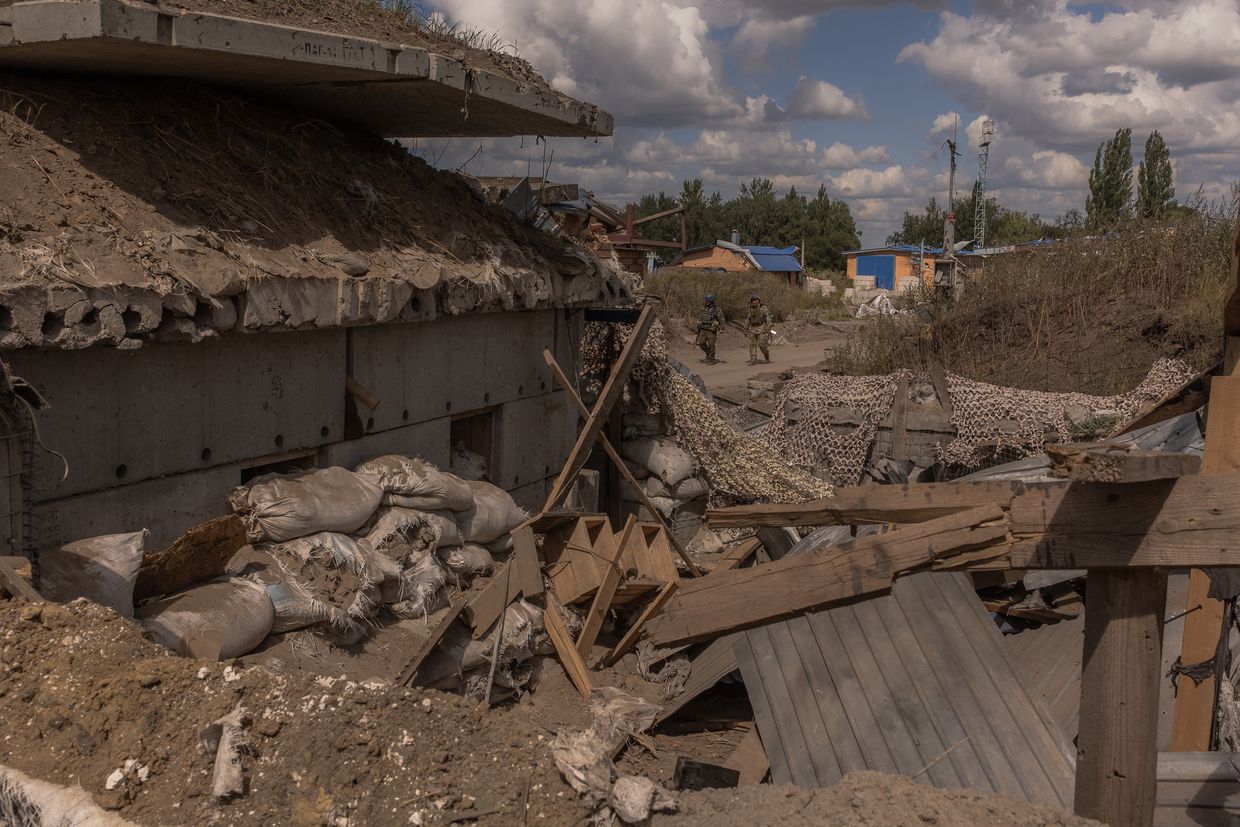
The missile completely destroyed the clinic building where the doctors and patients were located. The blast wave damaged neighboring multi-storey buildings and vehicles.
So far, 29 people have been reported injured: 7 people were killed, 22 were injured, including 12 women, 9 men and a 5-year-old girl
– , the police said in a statement.
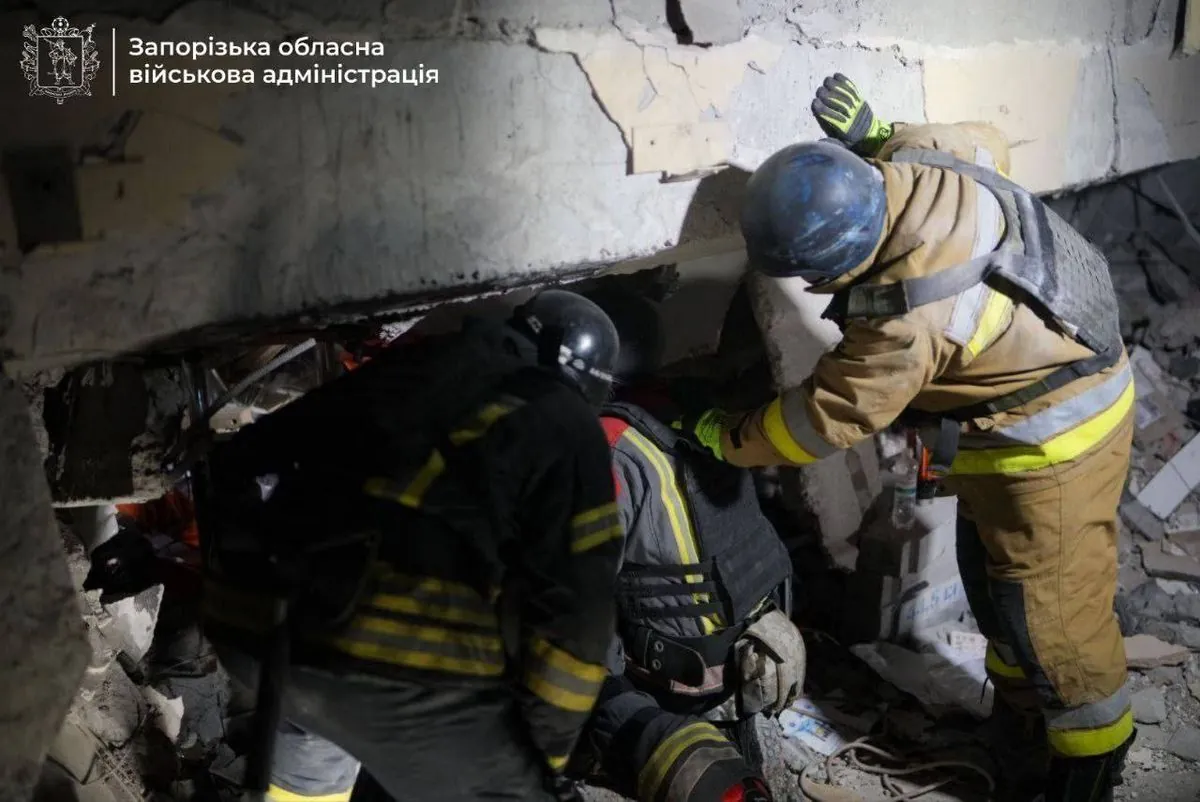
People may be trapped under the rubble. Rescuers, police and emergency services continue the search and rescue operation.
If you have lost contact with your family or friends, please call the special line “102” or 0504529195
– call the police.
Recall
As a result of an enemy strike on the city , 20 residential buildings and three non-residential buildings were damaged.
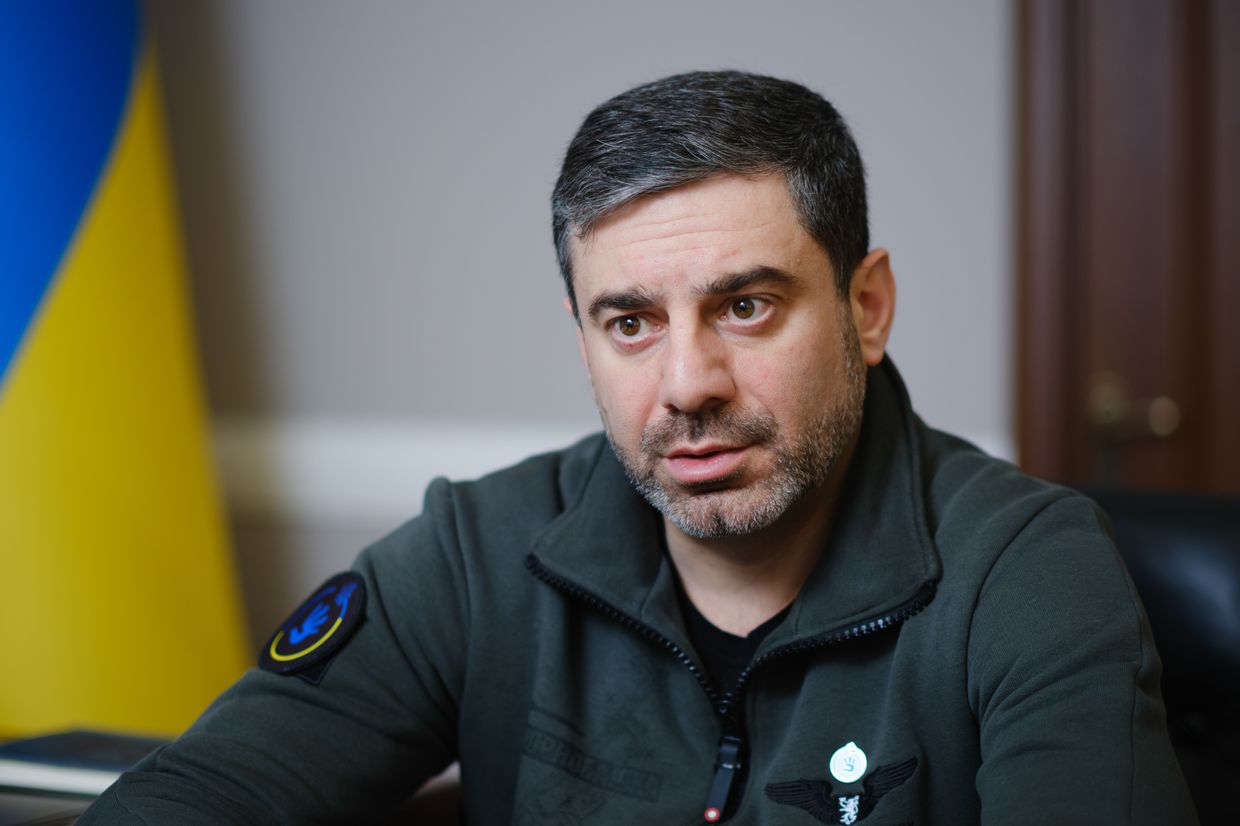
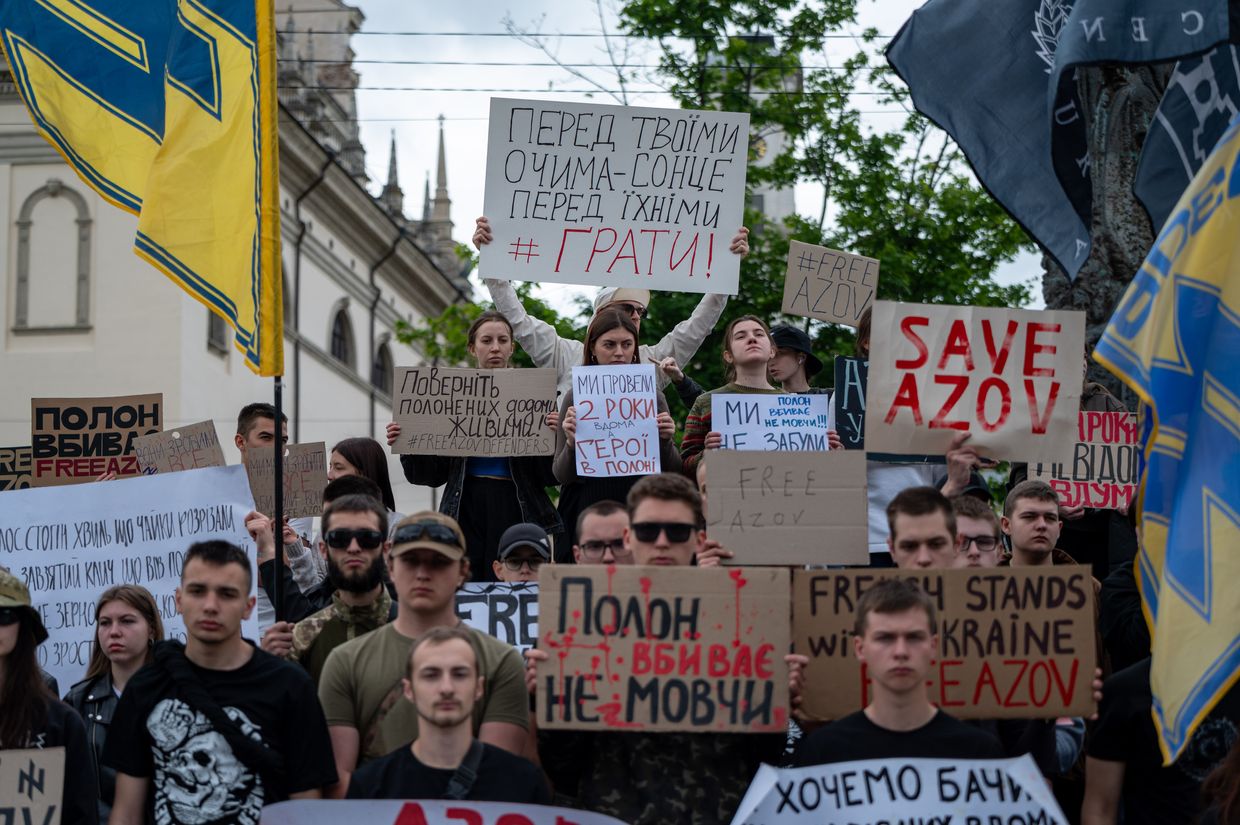
The Russian military summarily executed at least 109 Ukrainian prisoners of war (POW) in 2024, Ukraine’s Ombudsman Dmytro Lubinets said on national television on Dec. 10.
"In 2024 alone, we can confirm that Russian troops shot 109 Ukrainian prisoners of war," Lubinets said. Reports of murders, torture, and ill-treatment of POWs are received regularly by Ukrainian authorities.
The ombudsman added that 177 cases of POW executions were confirmed "during the previous years of the full-scale war."
It is not immediately clear whether he was referring to the overall figure of 177 captives who died in Russian captivity throughout the all-out war, as revealed by Victoria Tsymbaliuk, a representative of the Ukrainian Coordination Center for the Treatment of POWs, in October.
Nevertheless, the number of POWs killed in 2024 alone underscores an increased frequency of summary executions by the Russian military. This trend coincides with an accelerated pace of the Russian advance in Ukraine.
The figures refer only to officially confirmed cases, meaning the overall numbers may be higher.
"There are Russian representatives who are now cynically and publicly showing the whole world that they do not comply with international humanitarian law, the Geneva Conventions, they abduct children, they commit torture against the civilian population of Ukraine, they kill Ukrainian prisoners of war," Lubinets said.
The International Criminal Court issued arrest warrants for Russian President Vladimir Putin in 2023 for the forced deportation of Ukrainian children.
The Hague court also issued arrest warrants for ex-Defense Minister Sergei Shoigu and Valery Gerasimov, the chief of the General Staff of the Russian army. Shoigu and Gerasimov are charged with "directing attacks at civilian objects," "causing excessive incidental harm to civilians or damage to civilian objects," and the "crime against humanity of inhumane acts."
"Unfortunately, we do not see an effective reaction from the international community. We are very grateful for the deep concern, but as the war in Ukraine, which has been going on for more than 10 years, three years of full-scale war, shows, words do not stop Russia," Lubinets said.
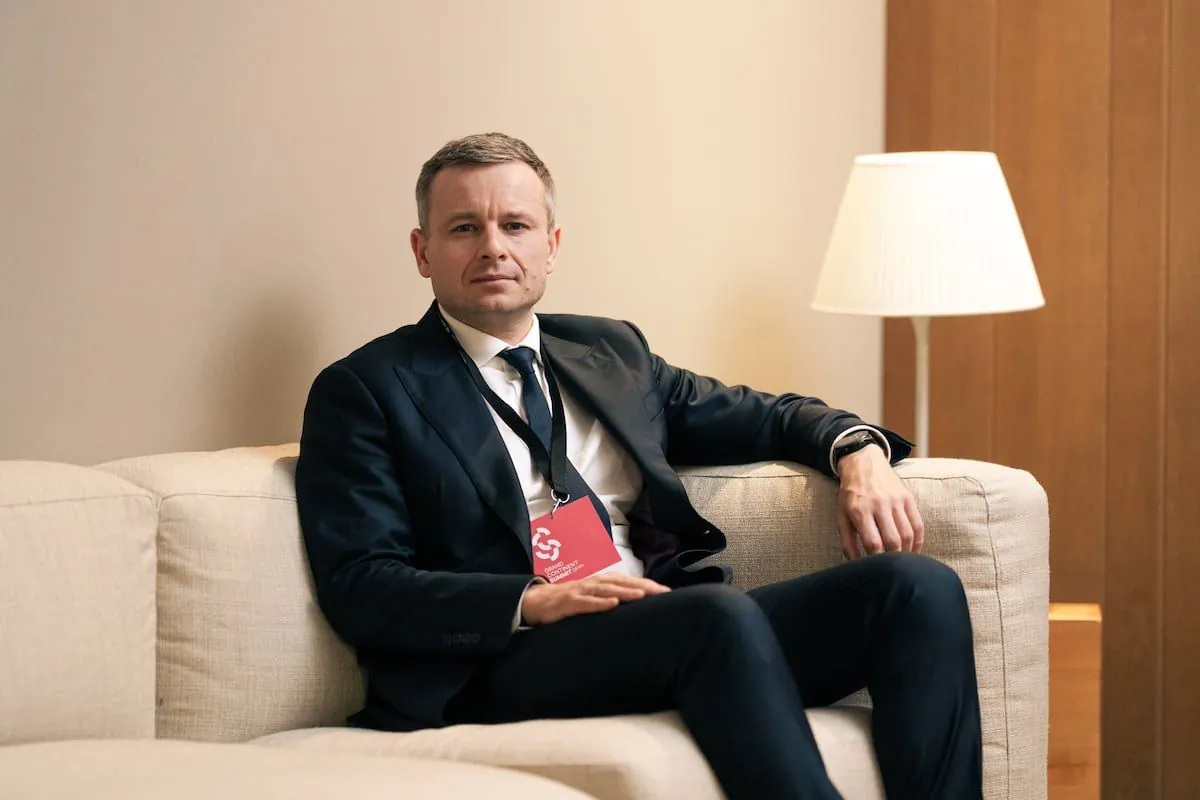
Finance Minister Marchenko said that funds and weapons are sufficient to counter the Russian Federation until mid-2025. Ukraine is preparing for possible changes in US support after the presidential election.
Ukraine has enough funds and weapons to fight against Russia for at least the first half of 2025 without the help of the United States under the new administration of Donald Trump, if it stops supporting Ukraine in the confrontation against the Russian Federation. This was stated by Finance Minister Serhiy Marchenko in an interview with the Spanish newspaper El Pais, reports UNN.
Details
Answering the question of what will happen if the United States stops providing assistance to Ukraine under the new administration of Donald Trump, Marchenko said that "Ukraine should have a plan to create the necessary conditions for cooperation with the new administration. Ukraine's natural interest is to create good Trust for cooperation. I believe that this should be a priority strategy for both Ukraine and Europe. We want to build good relations.
He noted that Ukraine should use the time properly and be able to reach an agreement with the new administration.
Marchenko stressed that Ukraine will have enough funds and weapons to resist the Russian Federation until the first half of 2025.
I believe that we have enough funds, enough weapons, rockets and artillery shells to resist at least until the first half of 2025. We will provide sufficient budget allocations for the purchase of ammunition and necessary military equipment in 2025. We are now receiving the necessary weapons from the United States. This means that at least for the first half of the year and beyond, we will be well equipped to withstand this attack. Ukraine should use this time very wisely to conduct the necessary negotiations with our key allies in the United States
Marchenko noted.
recall
US President-elect Donald Trump at a meeting with Ukrainian and French leaders Volodymyr Zelensky and Emmanuel Macron in December reiterated that he wants an immediate cease-fire in Ukraine and negotiations to end the war as soon as possible.
Editor's note: This is a developing story and is being updated.
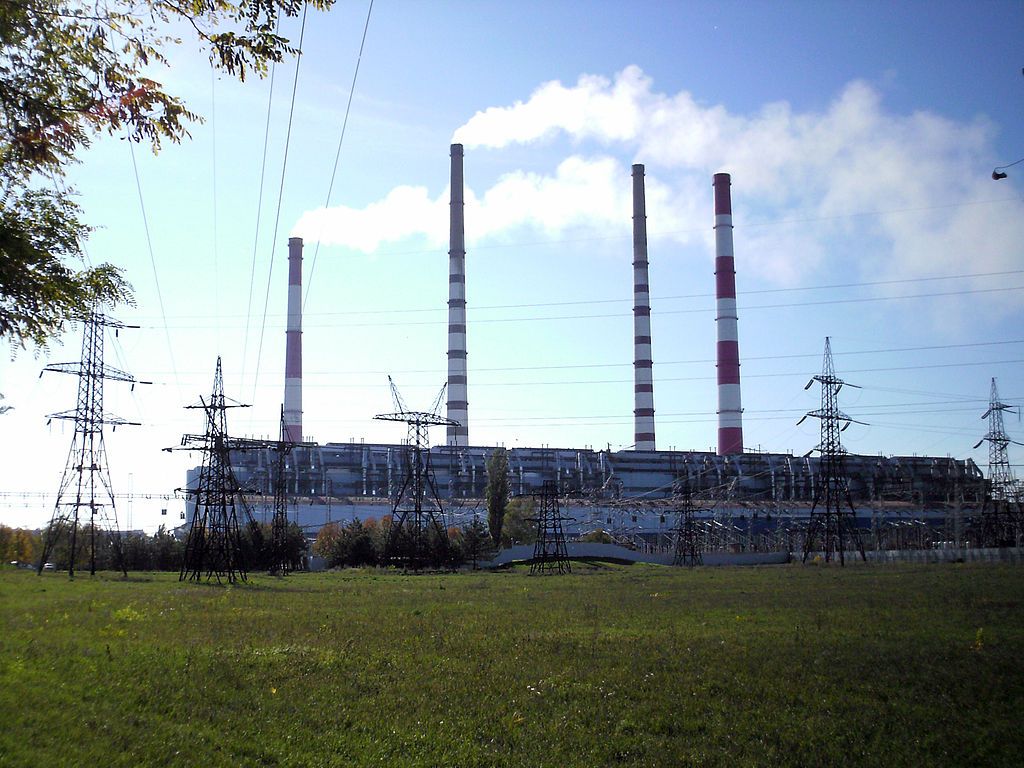
A Ukrainian missile attack struck a boiler plant in Russia's Rostov Oblast overnight on Dec. 11, damaging critical infrastructure in the city of Taganrog, local Russian officials claim.
Yuri Slyusary, the acting governor of Rostov Oblast, claimed that an overnight Ukrainian missile attack struck an "industrial facility" in Taganrog, damaging the facility as well as 14 cars in the parking lot.
Taganrog Mayor Svetlana Kambulova later reported that heating supply had been disrupted in 27 apartment buildings in the city following an attack on a boiler plant within the city.
Videos posted on social media capture a series of loud explosions in Taganrog around 3:30 a.m. local time.
The Kyiv Independent cannot independently verify any of the Russian claims, and Ukraine's military has not yet commented on the alleged attack.
The full extent of the damage was not immediately clear, although Slyusary claimed that there were no casualties as a result of the alleged attack. No additional details were provided by Russian officials.
The alleged attack on Russian critical infrastructure comes as Russia continues to increase its onslaught of attacks against Ukrainian energy facilities, as it seeks to plunge the country into another harsh winter aimed at testing Ukrainians' resolve.
In the most recent mass aerial attack on the country on Nov. 28, Ukrainian Energy Minister Herman Halushchenko said that Russia struck a "massive blow" to the nation's power grid.
Situated on the Russia-Ukraine border, Rostov Oblast has become a regular target of Ukrainian attack since the start of the full-scale invasion.
As a result of the Russian strike on Zaporozhye, 6 people were killed and 22 injured, four are still under the rubble. During the day, the invaders launched 268 strikes on 10 settlements of the region.
The Russian army on Tuesday, December 10, struck Zaporozhye. As a result of the attack, 6 people were killed and 22 were injured. Among the injured is a child. A private Polyclinic was destroyed. This is reported by the head of Zaporozhye RMA Ivan Fedorov, writes UNN.
Already 6 dead and 22 wounded – the number of victims as a result of the enemy strike on the Voznesenovsky District of Zaporozhye has increased. At night, rescuers of the State Emergency Service took out two women from under the rubble-they are in the hospital. There are four more people in the ruins of a building disfigured by a Russian rocket."
– notes the chairman of Zaporozhye RMA Ivan Fedorov.
It is also noted that during the day, the invaders inflicted 268 strikes on 10 settlements of the Zaporozhye region.
– 150 UAVs of various modifications attacked Stepnogorsk, Kamenskoye, Gulyai-pole, Shcherbaki, Novoandrievka, Novodanilovka, Malaya Tokmachka, Belogorye and Novodarovka.
– 109 attacks were carried out on the territory of Kamenskoye, Gulyai-pole, Shcherbakov, Novoandrievka, Novodanilovka, Malaya Tokmachka, Belogorye and Novodarovka.
33 reports of destruction of residential buildings and infrastructure were received.
In Zaporizhzhia, rescuers pulled two women from the rubble who had called 101Dec 10 2024, 09:40 PM • 13167 views
Some 25 miles south of the Russian border, explosions rumble off in the distance more or less continuously.
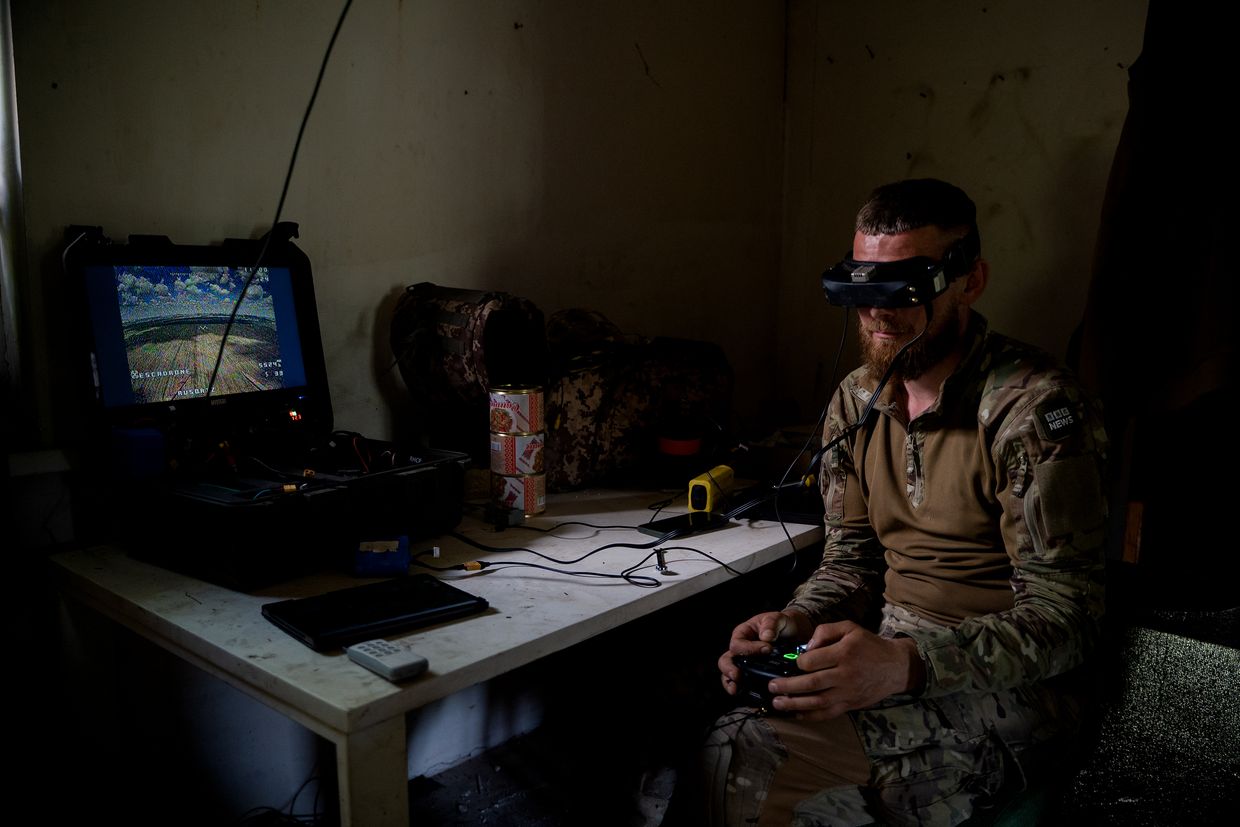
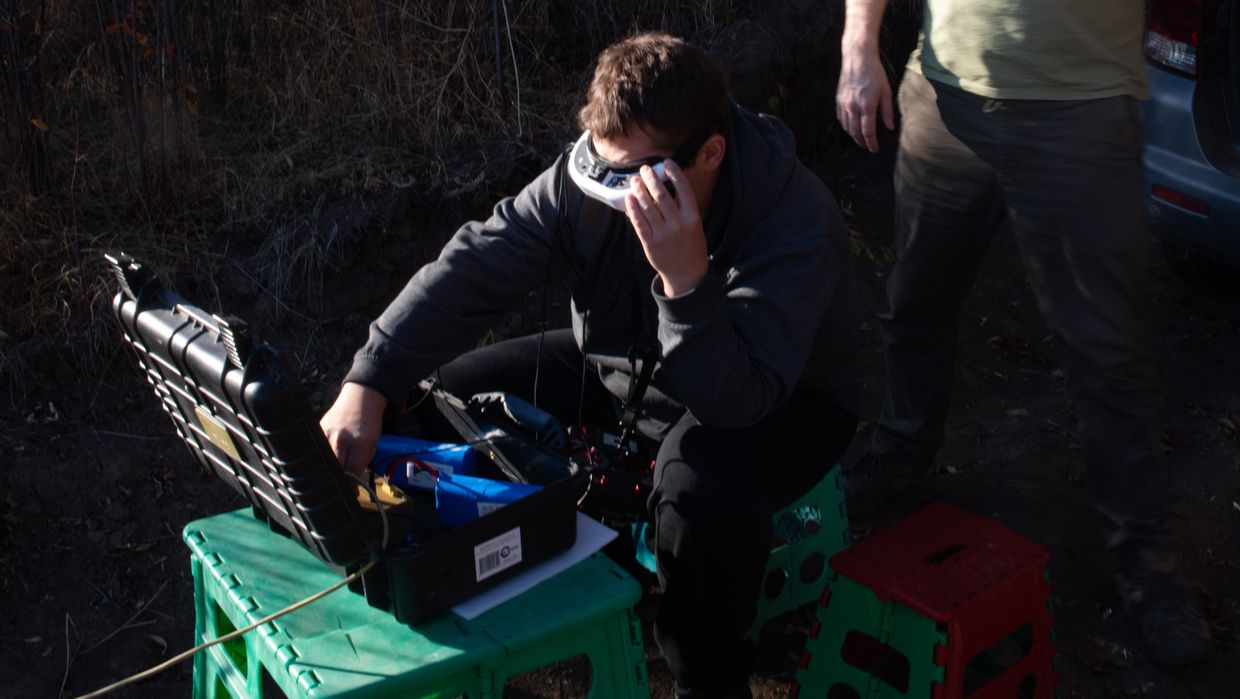
“We don’t even hear them anymore,” Zhenya chuckles from under first-person-view (FPV) goggles branded with the U.S. company “Fat Shark.”
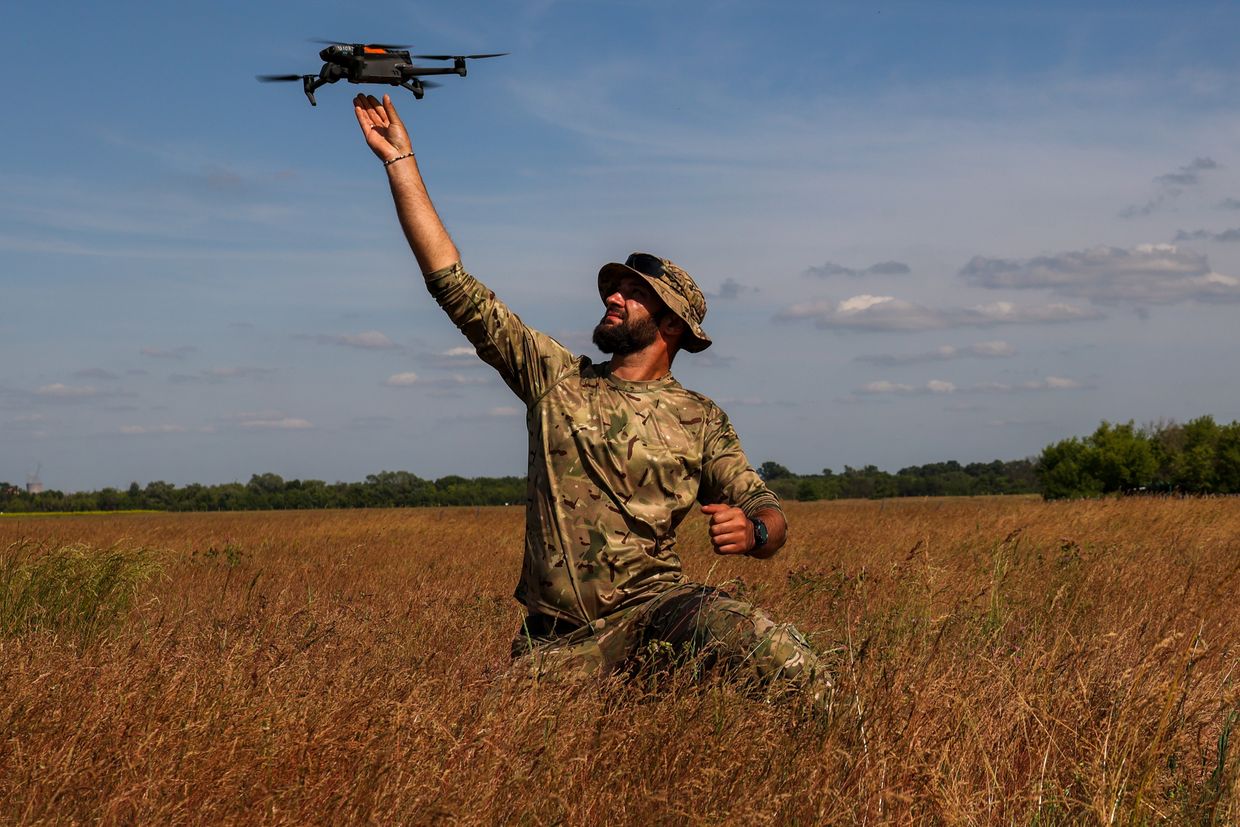
Zhenya and his co-developer for DragoDrones, or DCU, Maksym, are testing a stack of small FPV drones in a field in Kharkiv Oblast. They asked not to be identified by last name, due to the proximity of their workshops to Russian air power.
Most of the drones they made themselves. One is of ambiguous Chinese provenance — unmarked, maker unknown, and most importantly, not working.
Zhenya launches the drone into a couple of neat somersaults before sending it off into the distance. Around three kilometers away, Maksym gestures to a screen. The video is clipping out.
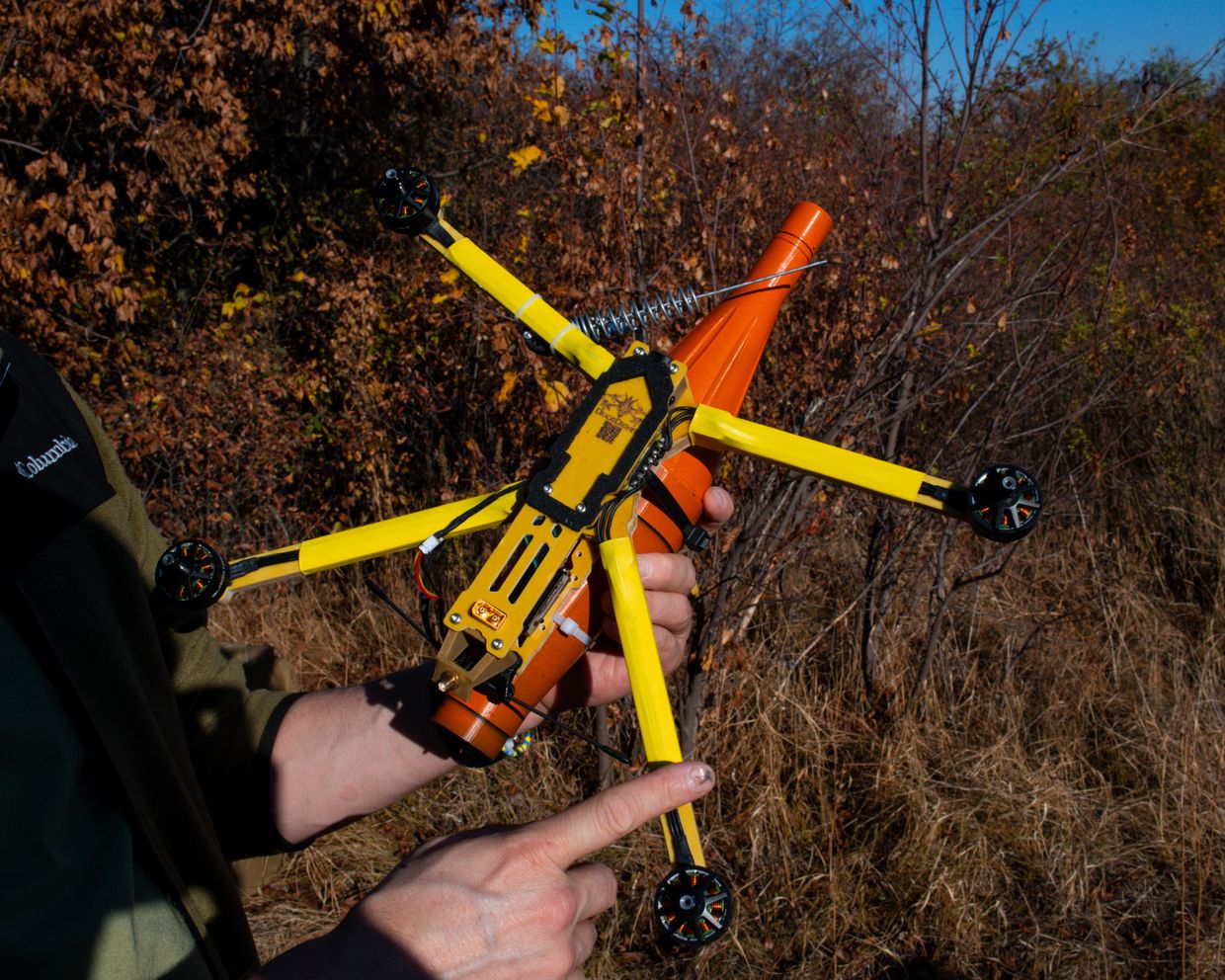
Maksym shows off DragoDrones' newest bomber model in an undisclosed location on Oct. 22, 2024 (Kollen Post / The Kyiv Independent).Zhenya puts on his FPV goggles and starts testing in an undisclosed location on Oct. 22, 2024. (Kollen Post / The Kyiv Independent).
It’s the bug that a brigade holding thousands of these drones has asked them to fix, explains Maksym: A faulty video transmitter, a cheap under-tested gadget that they're now replacing.
It’s a persistent problem with the drone supply to Ukrainian troops: Imported Chinese drones are often laden with defective parts. And while they have typically been cheap enough to merit replacing, China is actively cutting off its exports of components and materials critical to drone building.
In the face of these threats, Ukraine’s drone industry is increasingly onshoring the production of more ambitious components. And they’re getting better than anyone expected at building even the trickier gadgets needed to keep Ukraine’s army of drones in flight.
"We cannot rely on a Chinese supply chain," says Denys Nikolayenko, who makes high-end thermal cameras for drones, from an office in Kyiv.
Native drone
The first drones to see mass use in Ukraine following Russia’s invasion in February 2022 were cheap, off-the-shelf Chinese imports.
As the country realized the importance of these new weapons, Ukraine began building out its local drone manufacturing in the early months of the war. Thanks to heavy investment in the industry, a major proportion of drones on the front today are Ukrainian-made.
The components of those drones are a different matter. China’s chokehold on the supply chain has been a source of persistent alarm. Nataliia Kushnerska, head of Ukrainian defense tech hub Brave1, identified the “particular dependence on China” as one of the three biggest problems in Ukraine’s drone industry, speaking to Forbes Ukraine last November.
China made headlines in Ukraine for restricting drone components at the outset of September. Recent reports show China has already begun curbing sales to American and European drone makers and is readying more sanctions.
Zelensky addressed the nation referring to the Chinese controls announced in September, alluding to Ukraine’s new self-reliance: "Some of the largest state exporters of drone components are instituting export controls. We know what to do so that these controls don't become a critical threat to us."
"Some of the largest state exporters of drone components are instituting export controls. We know what to do so that these controls don't become a critical threat to us."
China sanctioned U.S. drone company Skydio in late October, barring Chinese manufacturers from selling to the firm. Skydio’s dependence on Chinese components, particularly motors, has led to backups at the firm. It has also exposed China’s readiness to weaponize its dominance in unmanned weapons.
“This is a clarifying moment for the drone industry,” Skydio CEO Adam Bry wrote to customers. “If there was ever any doubt, this action makes clear that the Chinese government will use supply chains as a weapon to advance their interests over ours.”
Ukraine’s manufacturers have gotten remarkably adept at replicating Chinese drone functionality at home, both out of concern for cost and concerns about China’s loyalties to Russia.
Herman Smetanin, minister of Strategic Industries, announced early in November that Ukraine had developed a “Shmavic,” a local copy of the DJI Mavics that were the first drones to see wide use following Russia’s full-scale invasion.
But the focus on the more minute elements within the supply chain for drone production is a newer phenomenon.
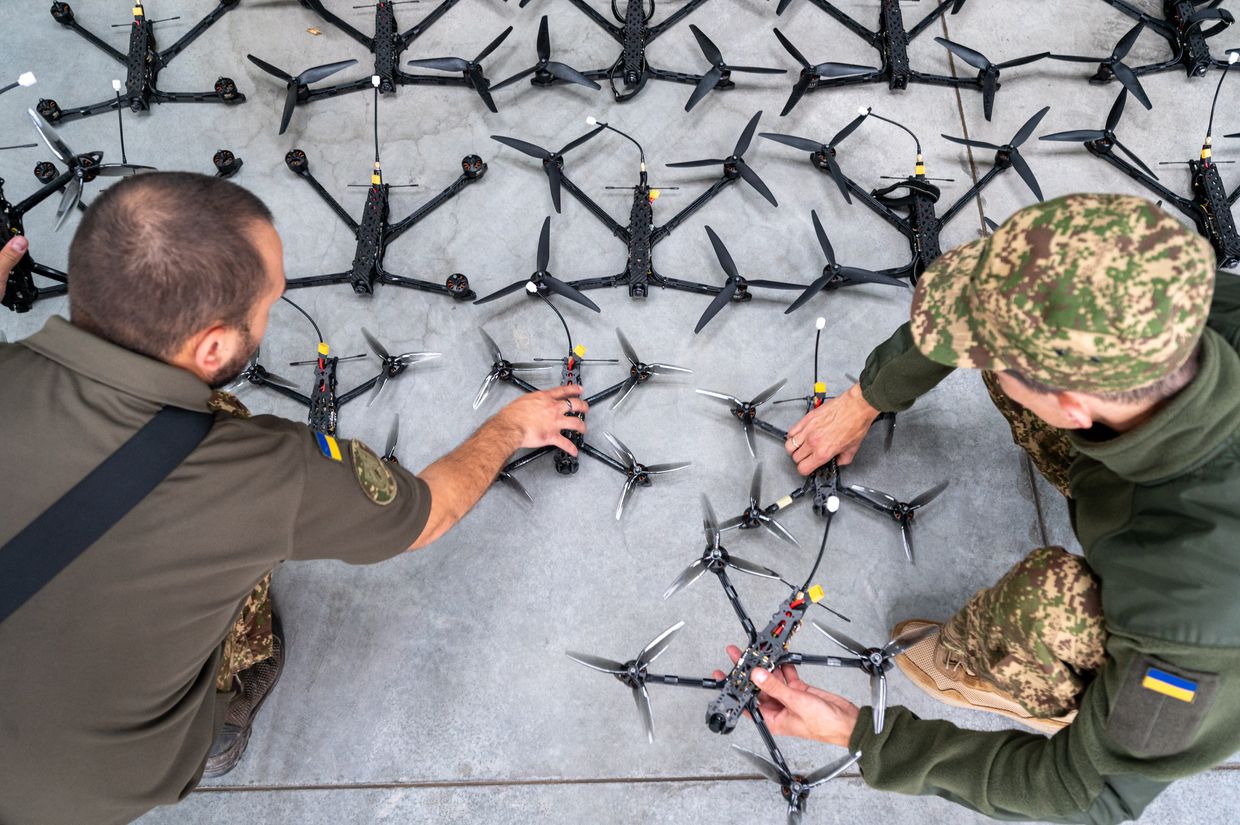
Ukrainian soldiers repair drones in a laboratory at an undetermined location in Donetsk Oblast, Ukraine, on Nov. 24, 2024. (Diego Herrera Carcedo/Anadolu via Getty Images)Soldiers of the Armed Forces inspect FPV drones during the handover from the volunteer organization in Lviv, Ukraine, on Sep. 13, 2024. (Stanislav Ivanov/Global Images Ukraine via Getty Images)
Producers like Zhenya and Maksym are increasingly equipping their own drones with parts made at home. Beyond their own frames routed out of Kharkiv-sourced foam plastic and 3D-printed fasteners, they recently got a Ukrainian computer numerical control machine — essential for precise tooling — and have begun buying motors from a new Ukrainian supplier.
The pair's drones run between $300 and $600, making them cheaper than off-the-shelf FPVs or Mavics with which they compete on function. Maksym and Zhenya have a lot more at stake in keeping those explosions from coming any closer than DJI or Autel do.
Beyond drone-specific components, China is also tightening controls on key raw materials, especially rare-earth metals key to certain higher-end gadgets on a drone.
"Before 2023 you could just buy germanium from China without any export controls or whatever procedures on Alibaba, two weeks later you got your germanium bricks here in Kyiv," reminisces Nikolayenko. "But in 2023 they started to control it."
NIkolayenko’s company, Oko Camera, needs germanium to make thermal lenses for drones. Despite being the Ukrainian word for “eye,” Oko is cautious about being overly visible as a company. Russian airstrikes remain a threat to local manufacturers, even those based in the Kyiv region. Oko lenses are maybe most famous for being the visual guidance of Ukraine's famous "Baba Yaga" drones, so dubbed by Russian soldiers after a mythical witch due to their ability to strike on the gloomiest of nights.
Displaying a trio of their lenses on a desk. Nikolayenko and his business manager, Nazariy Nikolaychuk, note that they’ve built many of their own machining tools, and specifically worked out an independent calibration process.
“The benefit is that actually you ensure the quality of the image of each camera that you produce, and this is not the case for some Chinese cameras. This makes us different,” says Nikolayenko.
The images are undoubtedly crisp, showing the twigs on trees and soldiers behind them, and even the thermal differential between hair and skin.
Long-term, Ukrainian drone makers are keen to sell to Western buyers, particularly after a ceasefire allows them to export. With increasing volleys of sanctions, many are betting that NATO will increasingly see Chinese parts, particularly the higher-tech ones, as a disqualifying feature for would-be suppliers.
Stay warm with Ukrainian traditions this winter. Shop our seasonal merch collection.
Nonetheless, there remain enduring concerns that many “Ukrainian-made” drones are Chinese imports barely modified and sent out to the front.
“They say the government bought a bunch of drones. The fact is, they bought them from China and stuck on some stickers of their own. And then they don’t work,” says Maksym.
And while local producers are trying their hands at new links in the supply chain, the most and least complicated elements still depend heavily on imports.
For Oko, the sensors remain strictly European. Though Nikolayenko says they’ve built some of their own machining tools, most manufacturers of everything within Ukraine remain dependent on imported machining tools — traditionally Chinese, but increasingly Indian and, for those who can afford it, European.
But for the cheapest components, simple base-line products like transistors, circuit boards, wiring, or solar cells, nobody can yet step up to the scale of China’s mass production.
While DragoDrones 3D-prints some of the components, and are prototyping more, the problem is not cost so much as speed. They lament that despite their clever workarounds, localized mass production within Ukraine was a pre-war casualty of bad policy.
“Production capacity is much bigger in Russia, plus China. In Ukraine, over the last fifteen years, they closed down the production of all the little electronics — at the hands of both our government and the Russians doing the financing,” says Zhenya.
“(The Russians) copy what we make, for the most part,” says Maksym. “We were the ones who started using drones because we had nothing else.”
The Biden administration is considering tougher sanctions against Russia's oil trade and shadow tanker fleet. The new restrictions may be similar to sanctions against Iran.
US President Joe Biden is looking for ways to blow up the Kremlin's War Machine. The restrictions will also affect the Russian shadow tanker fleet. This is reported by Bloomberg, reports UNN.
Details
The Biden administration is considering imposing new, tougher sanctions on Russia's lucrative oil trade, seeking to increase pressure on Russia's military apparatus weeks before Donald Trump returns to the White House.
Details of possible new measures are being worked out, but President Joe Biden's team is considering restrictions that may affect some types of Russian oil exports, Bloomberg reports, citing its own anonymous sources.
Biden has long resisted the move out of fear that it could trigger a jump in energy prices, especially in the run-up to last month's presidential election. But with falling oil prices amid global surpluses and growing fears that Trump could try to force Ukraine to make a quick deal with Russia to end its nearly three-year war, the Biden administration is now open to more aggressive action
– says a Bloomberg Post .
One of the models of tougher US sanctions may be the introduction of restrictions similar to those on Iranian oil.
The administration is also considering new sanctions aimed at the tanker fleet that Russia uses to transport its oil. New restrictions on the so-called shadow fleet may be made public in the coming weeks
– writes Bloomberg.
Such restrictions can lead to a sharp increase in oil prices in the shortest possible time, which will lead to tension in the global economy.
It will also increase tensions with both adversaries and partners through whom the US wants to restrict exports of sensitive goods such as chips and other technologies that fuel Russia's War Machine.
While these steps will be aimed at capitalizing on a weaker oil market, they will also be aimed at increasing pressure on Russia before Trump takes office. The president-elect has insisted on negotiations to end the war in Ukraine, and current officials say they want to give President Volodymyr Zelensky's government as much leverage as possible before any negotiations.
recall
The United Kingdom imposed sanctions on 18 Russian oil tankers and 4 LNG tankers. These are" the biggest sanctions against Putin's shadow fleet", which are aimed at undermining Russia's energy revenues.
Analysts from the crowd-sourced monitoring website DeepState Map reported on Dec. 10 that Russian forces had advanced in Sumy Oblast near the border village of Oleksandriya.
DeepState is a mapping project, independent but with close ties to the Defense Ministry, widely trusted as one of the most reliable sources of accurate information on territorial changes along the front line.
The map changes showed Russian forces occupying 2 square kilometers (0,8 square miles) in Sumy and advancing in the Kursk Oblast. These developments are reflected as of December 10.
Sumy Oblast authorities, including head of the Military Administration Volodymyr Artyukh, rejected the notion that Russian forces had breached the border, calling the reports "fake" and describing them as disinformation.
"Now, there is no data from the military on the change of the situation on the border; the situation is controlled," Artyukh said.
Sumy Oblast borders Russia's Bryansk, Kursk, and Belgorod oblasts. Residents of the vulnerable border communities experience multiple attacks per day.
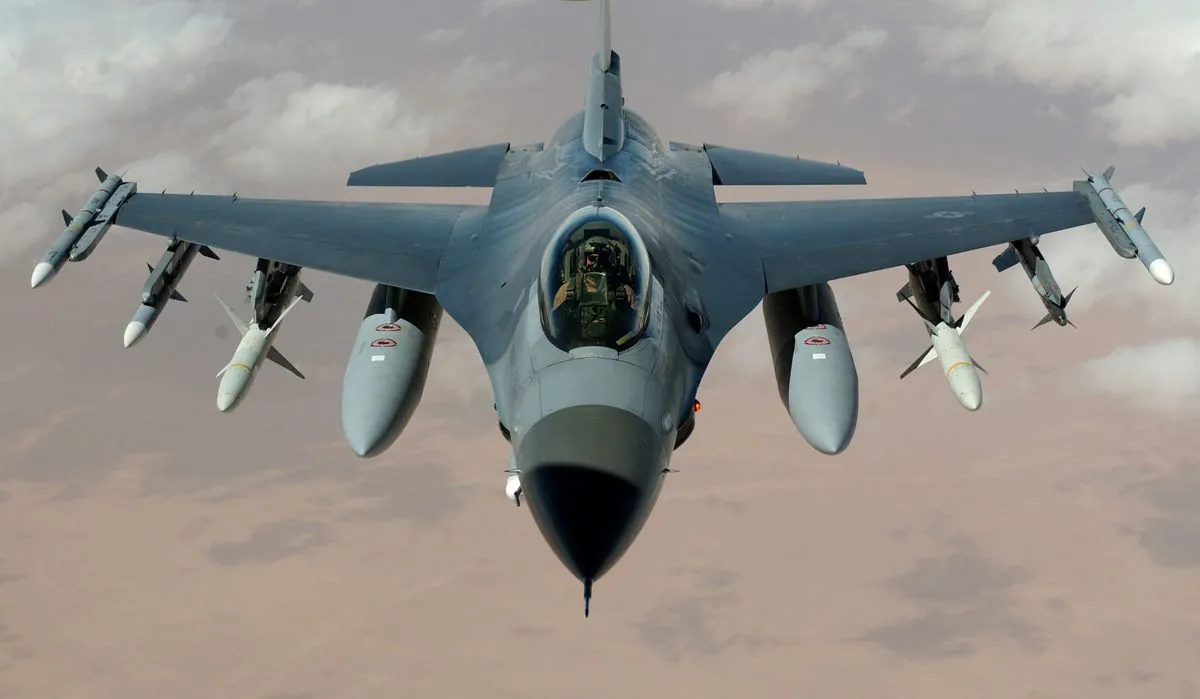
The US State Department has approved the sale of services and equipment for servicing the F-16 to Ukraine. the package includes mission planning systems, technical support and personnel training.
The US State Department has approved the sale of F-16 aircraft maintenance services to Ukraine for a total of.266.4 million. This is stated on the website of the agency for security cooperation of the US Department of Defense, writes UNN.
Details
The agency issued the required certificate and notified the US Congress about it.
The estimated total cost of all the declared equipment is 2 266.4 million.
The head jackets are claimed by Sabena (Charleroi, Belgium), Lockheed Martin Aeronautics (Fort Worth, Texas) and Pratt and Whitney (East Hartford, Connecticut).
It is noted that this aid package will improve Ukraine's ability to resist current and future threats, providing it with a more powerful air defense system for performing self-defense missions and ensuring regional security.
recall
In November, Zelensky reported the first success of F16 in Ukraine – the destruction of seven cruise missiles flying at civilian targets.
The Netherlands says goodbye to F-16s: Fighter jets that have served for 45 years are being transferred to UkraineSep 28 2024, 02:22 AM • 68802 views

 The Kyiv IndependentDmytro Basmat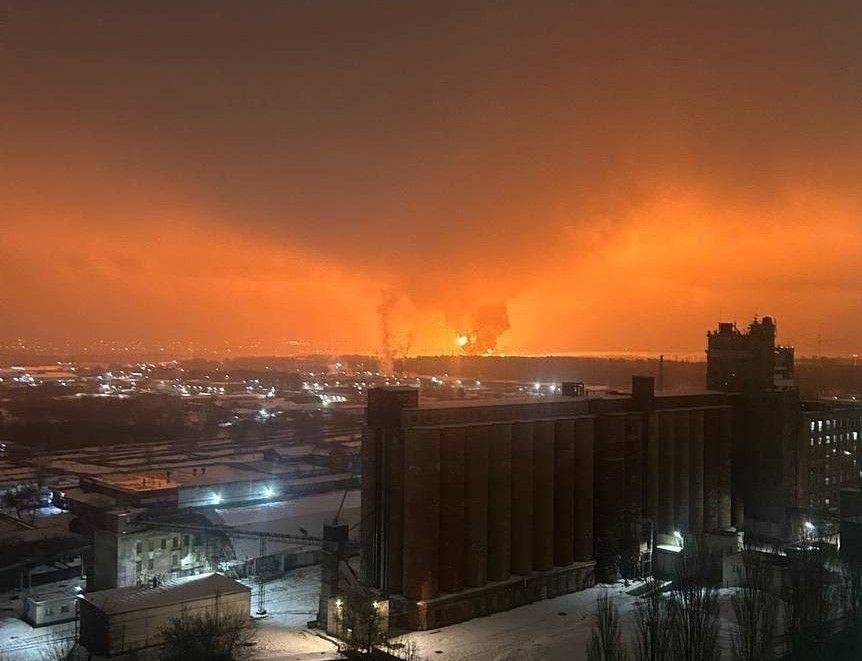







 shop now